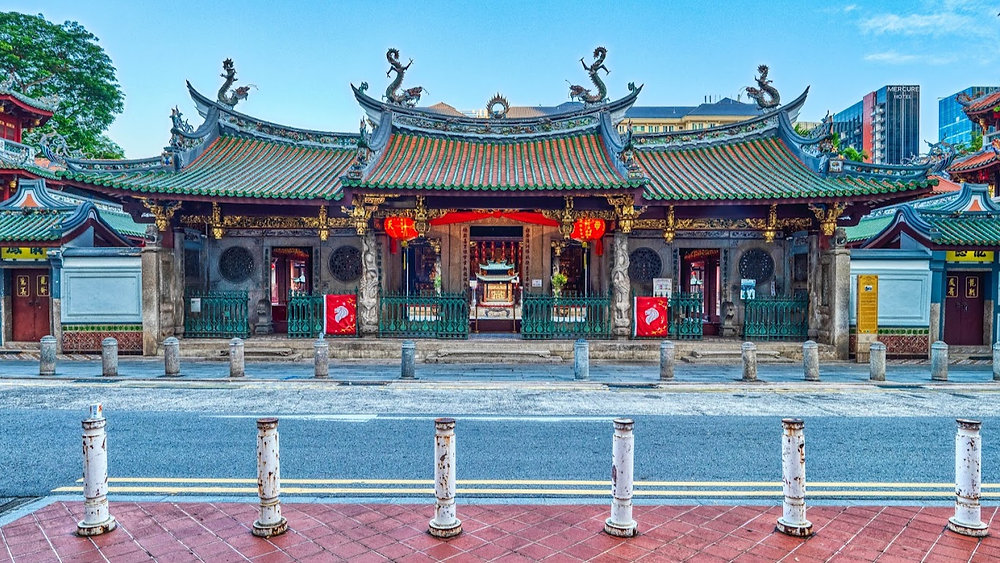
Have you ever walked through Singapore’s busy Central Business District and suddenly found yourself standing in front of a beautifully decorated temple that feels like it belongs to another era?
That is exactly the feeling many people get when they visit Thian Hock Keng Temple.
Surrounded by modern skyscrapers along Telok Ayer Street, this historic temple tells a very different story about Singapore. Before glass towers and office buildings filled the area, this neighbourhood was closely connected to the sea and was home to early Chinese immigrants who arrived by boat hoping to build a new life.
In this guide, you’ll discover why this temple is more than just a beautiful building. We’ll look at its history, architecture, cultural importance, visitor tips, and why it remains meaningful for Singapore locals today.
The Story Behind Thian Hock Keng Temple
Every old building has a story, but few places in Singapore tell the immigrant story as clearly as this temple.
Thian Hock Keng Temple was built between 1839 and 1842 by the Hokkien community in Singapore. At that time, many Chinese immigrants arrived from southern China by sea. Their journeys were long, uncertain, and often dangerous.
Before stepping onto Singapore’s shores, many sailors and merchants prayed to Mazu, the Chinese sea goddess, asking for protection during their voyage.
When they arrived safely, they wanted a place to give thanks.
That was the reason the temple was created.
The name “Thian Hock Keng” roughly translates to “Temple of Heavenly Happiness.” The temple became a spiritual home for early Hokkien settlers and a gathering place where the community could worship, celebrate festivals, and support one another.
What makes the story even more interesting is the temple’s location.
Today, Telok Ayer Street sits inland, surrounded by offices and restaurants. But in the 19th century, this area was close to the shoreline. Ships could anchor nearby, making the temple one of the first landmarks many immigrants saw after arriving in Singapore.
It was not just a religious building. It was a symbol of hope.
Why Thian Hock Keng Temple Matters in Singapore’s History
Many visitors see the temple’s colourful carvings and beautiful entrance, but the real value lies in the history behind those details.
Singapore was built by many communities, and the Hokkien people played an important role in the island’s early development. They became involved in trade, business, and community building.
The temple reflects that journey.
A Home for Early Immigrants
For newcomers arriving in Singapore, life was not always easy. Many immigrants had no family nearby and had to create new support networks.
Temples like Thian Hock Keng provided more than religious services. They became places where people could:
- Meet others from the same hometown
- Seek community support
- Celebrate traditional festivals
- Preserve cultural practices
The temple was closely connected with the social life of the Hokkien community.
A Link Between Singapore’s Past and Present
One of the fascinating things about Thian Hock Keng Temple is how naturally it exists alongside modern Singapore.
You can walk out of the temple and immediately see office workers, cafes, and high-rise buildings.
This contrast shows something unique about Singapore: the country continues moving forward while protecting important parts of its past.
The Architecture: A Masterpiece of Traditional Chinese Design
The first thing that catches your attention when visiting Thian Hock Keng Temple is the architecture.
Unlike many modern buildings that focus on simplicity, traditional Chinese temples are filled with details. Every carving, colour, and symbol has meaning.
The temple follows traditional southern Chinese architectural styles, especially influences from Fujian province, where many early Hokkien immigrants came from.
The Entrance Tells a Story
The temple’s entrance is designed to impress visitors immediately.
Look closely and you’ll notice:
- Detailed stone carvings
- Dragon decorations
- Traditional paintings
- Decorative tiles
- Elaborate wooden structures
These details were created by skilled craftsmen and represent prosperity, protection, and good fortune.
The Temple Layout Has Meaning
Traditional Chinese temples are carefully planned.
The different sections are not arranged randomly. The design guides visitors through different spiritual spaces.
The main worship area houses Mazu, while other sections honour different deities.
For someone visiting for the first time, it can feel like entering a museum where every corner has a story.
Who Is Worshipped at Thian Hock Keng Temple?
The main deity worshipped at Thian Hock Keng Temple is Mazu, also known as the Goddess of the Sea.
For communities with strong connections to fishing and maritime trade, Mazu has always been an important figure.
She represents:
- Protection during journeys
- Safety at sea
- Peace and guidance
Besides Mazu, other deities are also worshipped in the temple.
This reflects the traditional Chinese religious practice of honouring different figures associated with various aspects of life, from health and prosperity to protection and family wellbeing.
Visiting Thian Hock Keng Temple: What You Should Know
Planning a visit? The good news is that the temple is easy to include in a Singapore city walk.
It is located at:
158 Telok Ayer Street, Singapore
The nearest MRT stations are:
- Telok Ayer MRT Station
- Tanjong Pagar MRT Station
- Chinatown MRT Station
Because of its central location, you can easily combine your visit with nearby heritage attractions.
Best Time to Visit
The temple is beautiful throughout the day, but many visitors prefer:
Morning:
A quieter atmosphere with fewer crowds.
Late afternoon:
Good lighting for appreciating the architecture and taking photos.
During major Chinese festivals, the temple becomes more lively with decorations, ceremonies, and worshippers.
How Long Should You Spend There?
You do not need hours to appreciate the temple.
For most visitors:
- 20–30 minutes is enough for a quick visit
- 45–60 minutes allows you to explore details properly
If you enjoy history, photography, or architecture, you may want to stay longer.
Visitor Etiquette: What Locals Should Know
Even though Thian Hock Keng Temple is a popular heritage attraction, it remains an active place of worship.
A few simple habits help show respect:
- Dress appropriately
- Keep your voice low
- Avoid disturbing worshippers
- Ask before photographing people during prayers
- Observe signs regarding restricted areas
You do not need to follow any religious practice to visit. Many people come simply to appreciate the history and architecture.
Things to Notice During Your Visit
A quick walk around the temple can reveal details that many visitors miss.
Here are some things worth looking out for:
The Stone Columns
The temple features impressive stone columns with detailed carvings. These were created to demonstrate craftsmanship and add symbolic meaning to the structure.
The Dragon Decorations
Dragons appear frequently in traditional Chinese architecture. They often represent power, protection, and good fortune.
The Roof Details
The colourful roof decorations are not just for decoration. They often include symbolic figures connected to Chinese mythology.
Taking a slower look helps you appreciate how much thought went into every part of the temple.
Why Singapore Locals Should Visit Thian Hock Keng Temple
Many Singapore residents pass through Telok Ayer without ever stepping inside.
That is understandable. When you live somewhere, famous places can sometimes become invisible.
But visiting this temple offers something different.
It reminds us that Singapore’s story did not begin with modern buildings, shopping malls, or financial districts.
It began with people.
People who arrived with dreams, struggles, traditions, and hopes for a better future.
For younger Singaporeans especially, places like Thian Hock Keng Temple offer a chance to understand where earlier generations came from and how different communities shaped the country.
Nearby Places to Explore After Your Visit
One advantage of visiting Thian Hock Keng Temple is that it sits in one of Singapore’s richest heritage areas.
After exploring the temple, you can visit nearby spots such as:
- Telok Ayer Street’s historic shophouses
- Chinatown’s cultural attractions
- Maxwell Food Centre for local dishes
- Ann Siang Hill for cafes and heritage buildings
A short walk around the area feels like a journey through different chapters of Singapore’s history.
Frequently Asked Questions About Thian Hock Keng Temple
Is Thian Hock Keng Temple free to enter?
Yes, visitors can enter the temple for free. It is open to both worshippers and people who want to explore Singapore’s heritage and architecture.
What religion is practised at Thian Hock Keng Temple?
The temple follows traditional Chinese religious practices, with Mazu as the main deity worshipped there. It also honours other Chinese deities.
Can tourists take photos inside Thian Hock Keng Temple?
Photography is generally allowed, but visitors should be respectful. Avoid using flash during prayers and do not disturb worshippers.
How do I get to Thian Hock Keng Temple by MRT?
The closest MRT stations are Telok Ayer MRT Station and Tanjong Pagar MRT Station. Chinatown MRT Station is also within walking distance.
Is Thian Hock Keng Temple worth visiting for Singapore residents?
Yes. Even locals who have lived in Singapore for years can discover something new there. The temple offers a direct connection to Singapore’s immigrant history and cultural roots.
Conclusion
Singapore changes quickly, but places like Thian Hock Keng Temple remind us of the stories that built the country.
Behind its beautiful carvings and traditional design is a deeper story about courage, community, and the journeys of early immigrants who arrived by sea.
Whether you are interested in history, architecture, photography, or simply discovering a quieter side of the city, this temple is worth adding to your list.
The next time you are around Telok Ayer, take a few minutes to step inside. Look beyond the decorations, notice the details, and think about the generations of people who found hope within those walls.